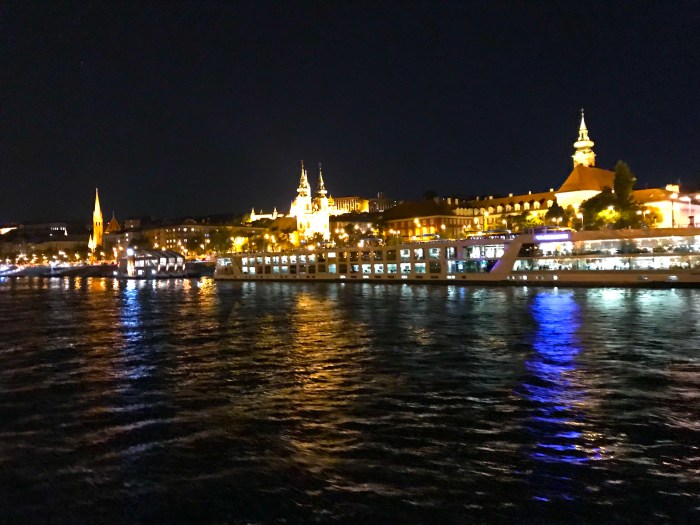
Welcome To Budapest At Night!
A few years ago, my wife Alex and I spent two days in Budapest, Hungary – enjoying the people, the history and of course the food! At night, we’d walk along the Danube River, where you can see all of the architecture brightly lit up!

Our Hungarian “Food With A View!”
Let me say I am NOT a fan of their political system but can’t blame the people who live there for that. Outside of the incredible architecture, we loved the people’s energy and love of food – and one night we saw the two collide head on when we visited the city’s massively popular “ruin bars!”
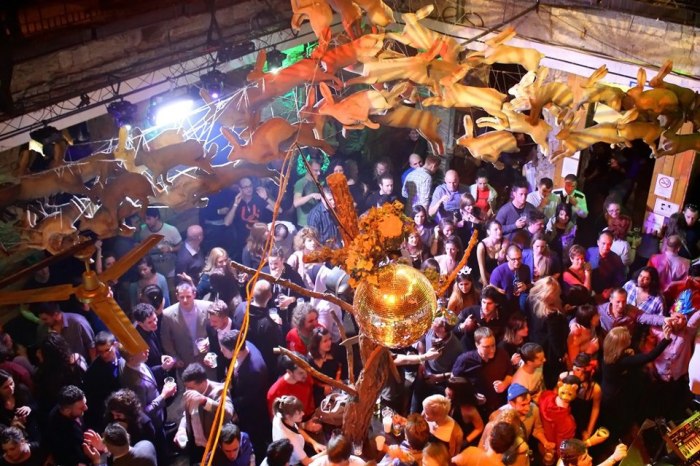
Budapest “Ruin Bars!”
Alex and I loved walking around in Budapest, where modern architecture takes second fiddle to the city’s rich past. There are no better examples of that than “Ruin Bars” – unique bars and cafes that have been built in Budapest’s old District VII neighborhood – the old Jewish Quarter.

They are called “ruin bars” for exactly that reason: they have risen from the ruins of abandoned buildings in this neighborhood, which has been left to decay since the end of World War II.

This is a great shot I found online, an overview of the Mazel Tov ruin bar…what a beautiful space!
Here is a description of Budapest’s ruin bars, which describes them perfectly:
“In the early 2000s, the inner part of the VII District was made up of crumbling, abandoned buildings. Once the site of the Jewish ghetto, the historic Jewish Quarter became dilapidated in the decades following World War II, after the deportation of 10,000s Jews. In 2002, the guys behind Szimpla opened up the very first venue on Kertész utca – where you’ll find the Szimpla Café today. However, the real kick happened in 2004, when Ábel Zsendovits and his friends decided to gamble on a condemned building complex on Kazinczy street, which marked the start of the legendary ruin bar we all know and love today.”
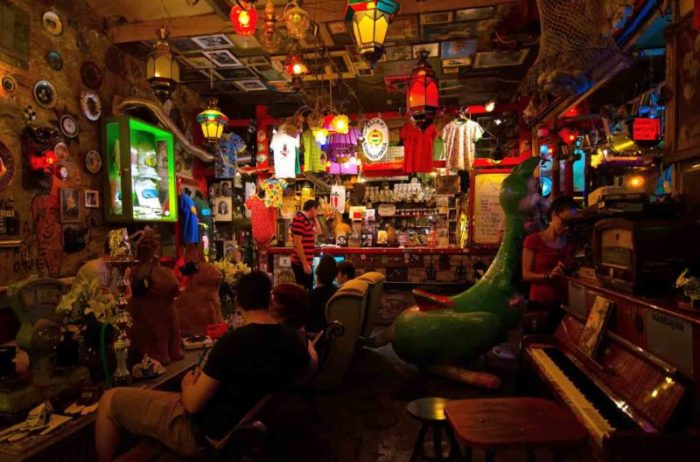
Welcome To “Szimpla Kurt!”
“Szimpla began as a small experiment, a bar set up in an abandoned building offering affordable drinks for the young and creative crowd in Budapest. Szimpla became a bohemian hub after the crumbling building got spruced up with local design and vintage, mismatched furniture. Its chaos and eclecticism has turned it into one of the world’s most famous bars.”
Thanks to the website “Budapestflow.com” for these descriptions..you can see more here:
https://budapestflow.com/history-ruin-bars-budapest/
Armed with this information, Alex and I headed out early – about 10p – to find these bars, which were just opening for the long night:
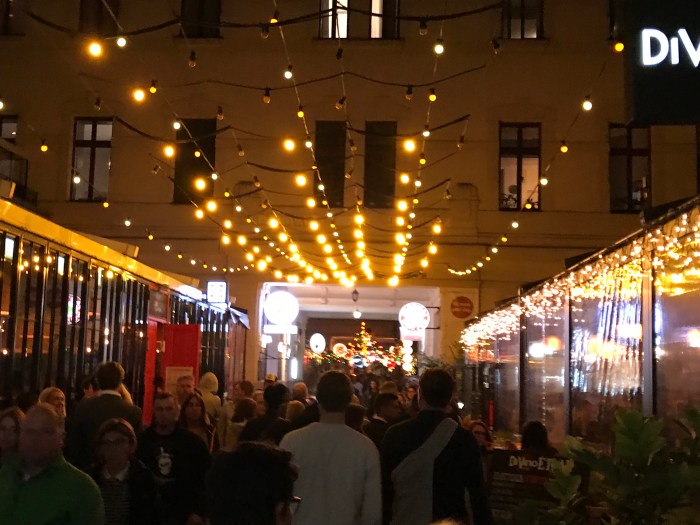
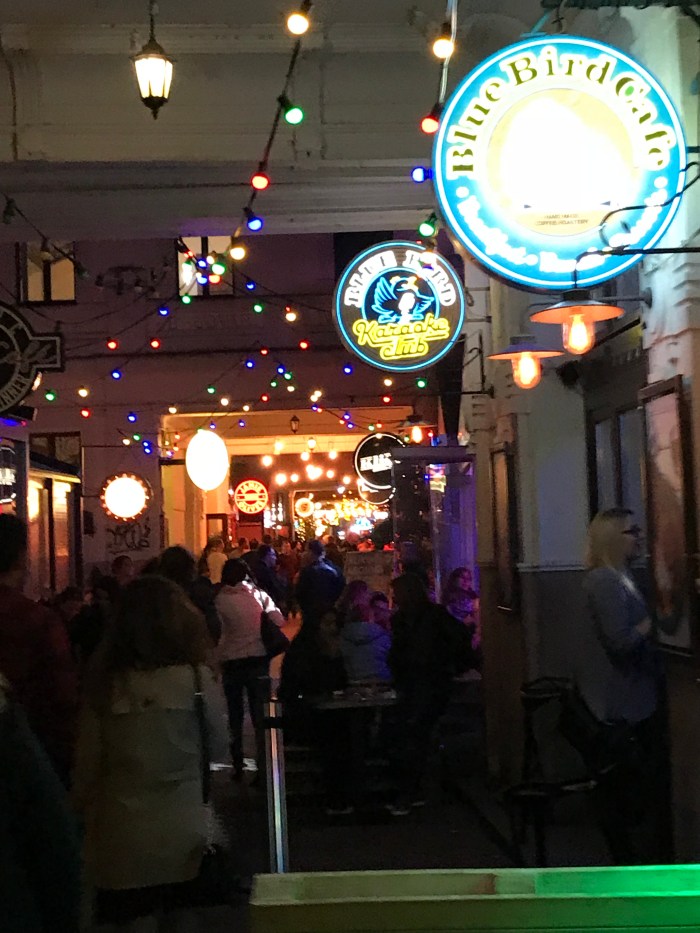
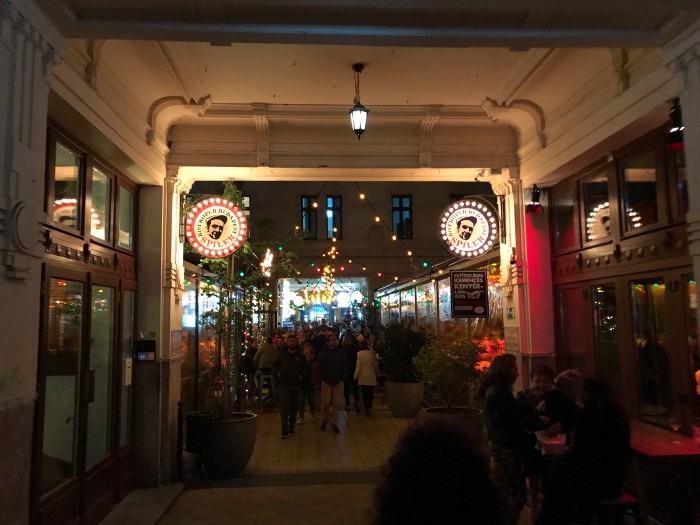
Once we hit the Jewish Quarter, we immediately found long narrow alleys that were filled with restaurants and bars, and packed with people:
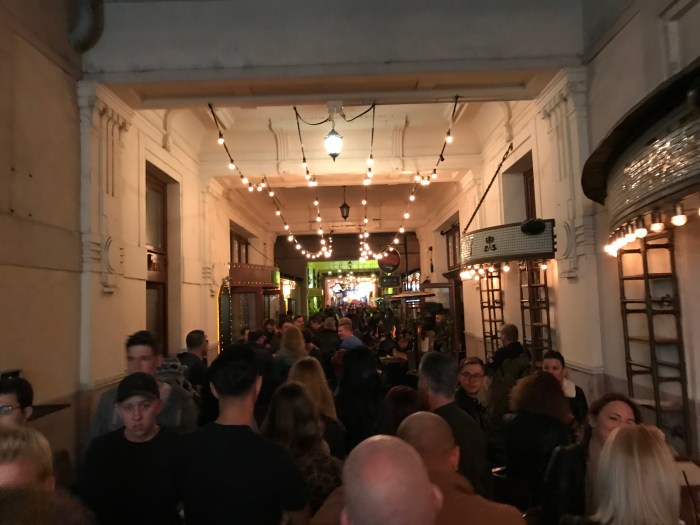

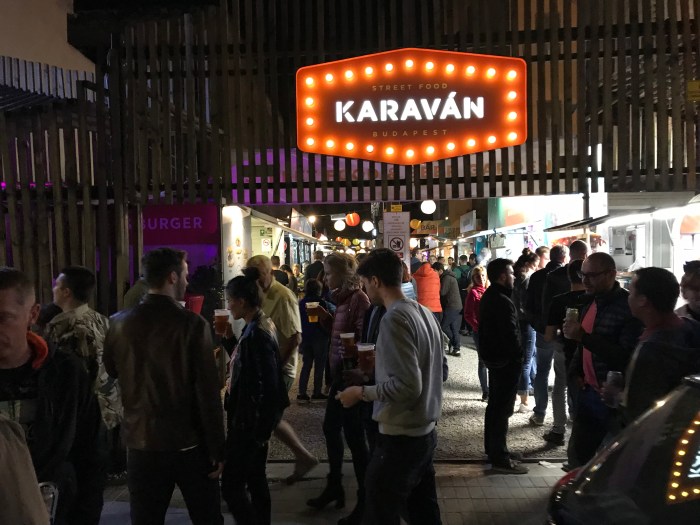
We headed into the Karavan food court, lined on both sides with takeaway food stalls and bars – lots and lots of bars…it was crowded but not uncomfortably so – and everyone was in great spirits, so we got in line and got some drinks – and pondered a local delicacy:
There were signs for unique Hungarian food like this:
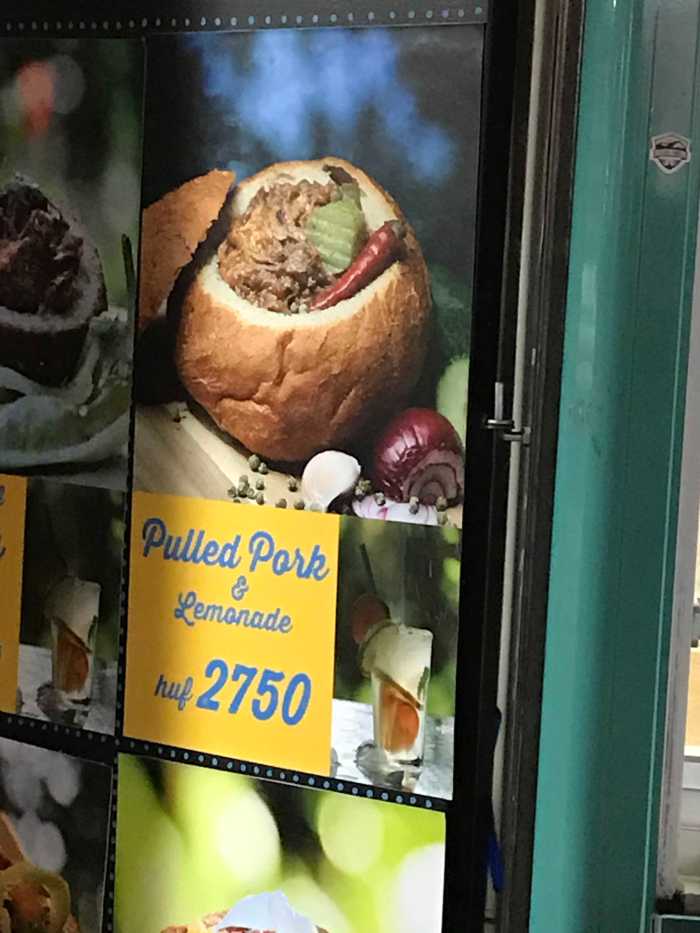
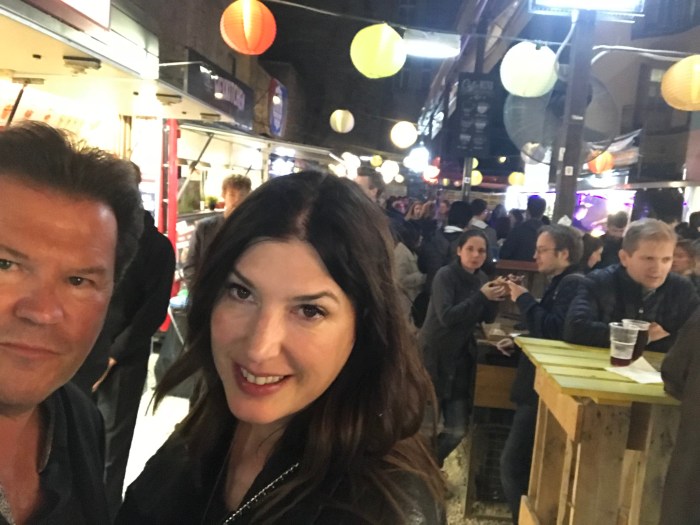
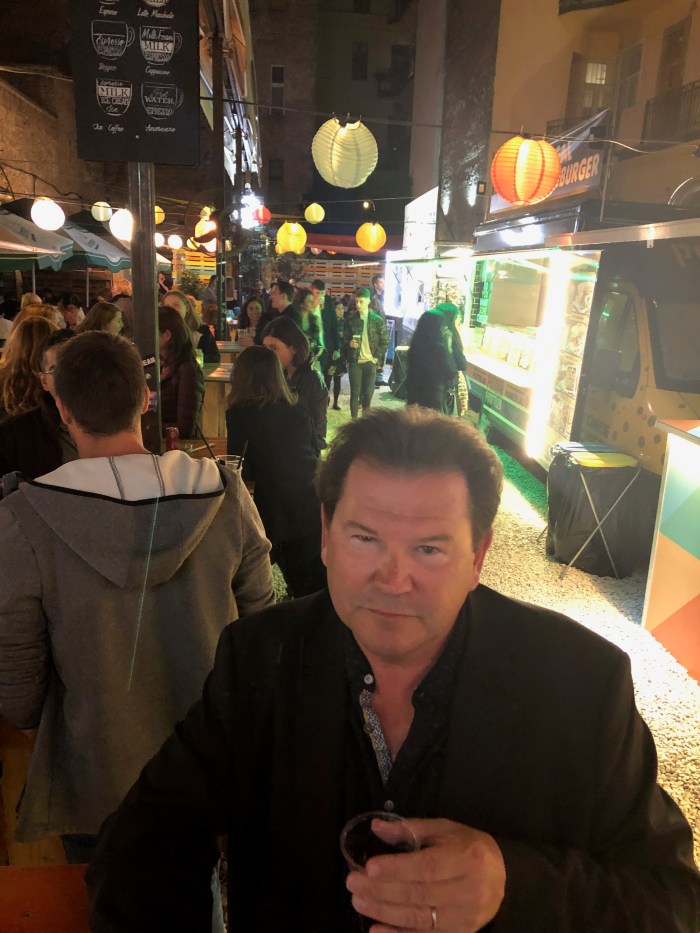
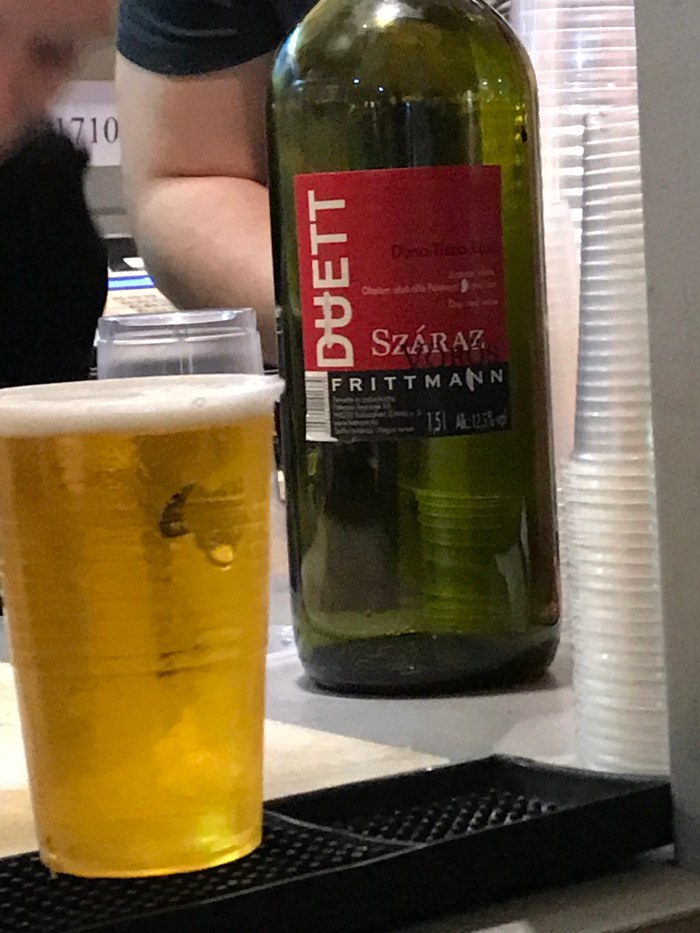
I didn’t get the pulled pork and lemonade sandwich that night, but we did try Hungarian red wine, which was delicious, as well as several local beers – and then we decided to find the most famous “ruin bar” of all: Szimpla Kert!
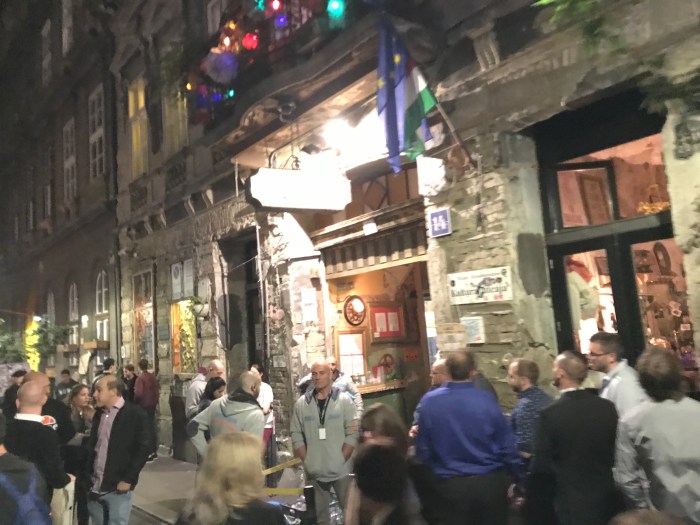
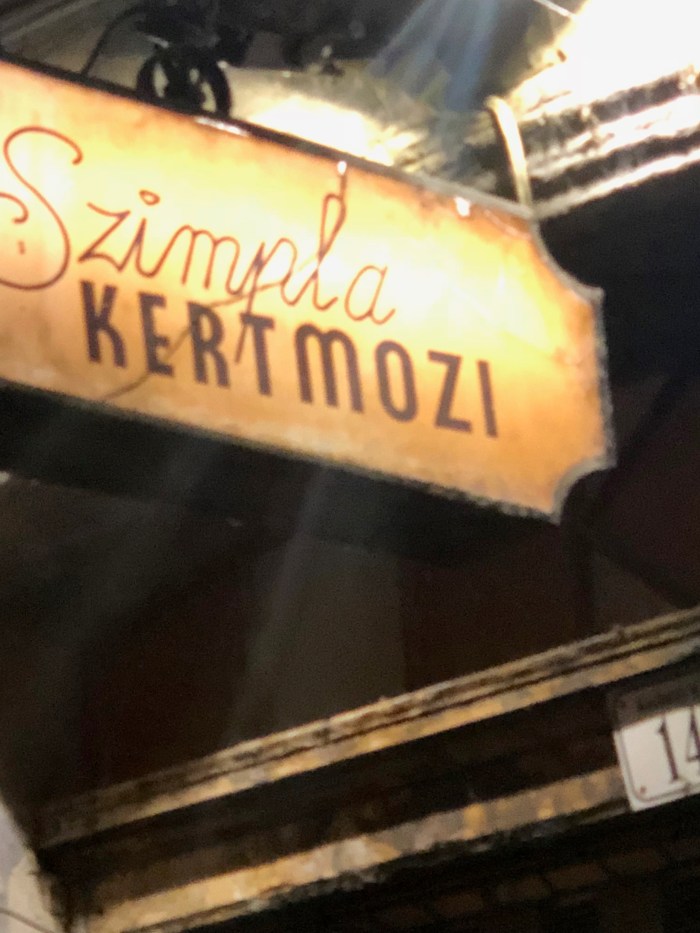
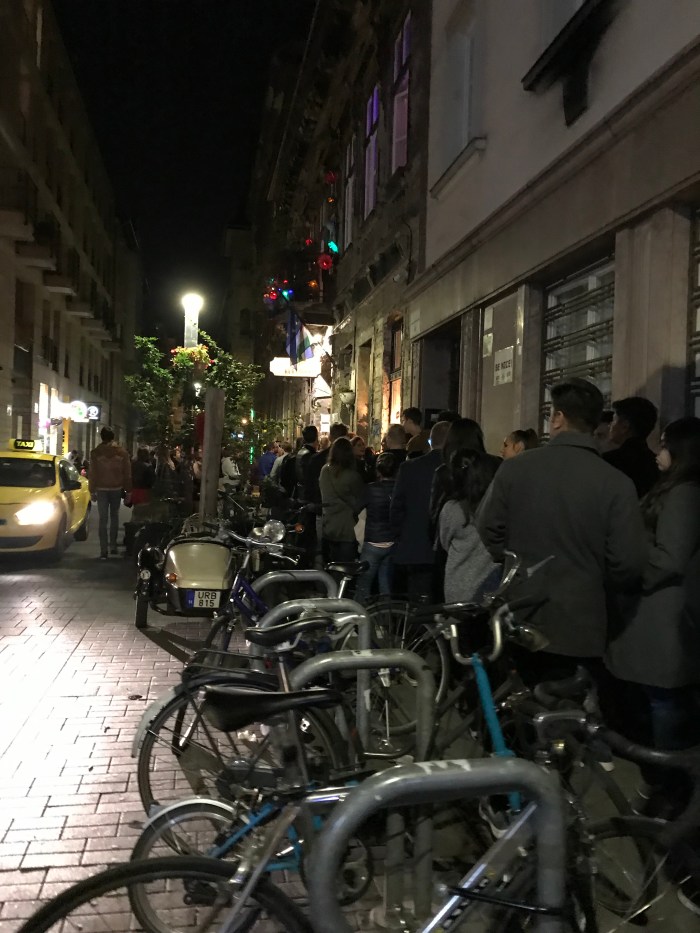
Yes, look at how long this line was to get in!
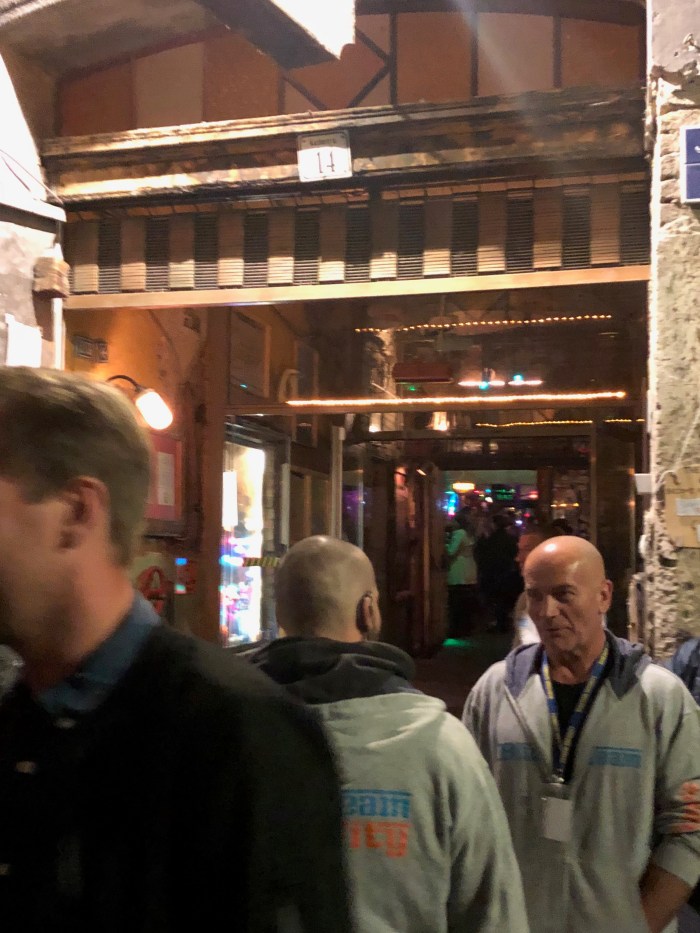
Szimpla Kert Was Over-Served!
Yes, these are shots of the outside of the place, as there was a massive line, which we stood in for 15 minutes before deciding it would take too long to get in – and so we left without seeing the inside of the famous Szimpla Kert, as we had to get up really early to get our train…that said, we had a blast wandering the streets of Budapest and popping into the makeshift food courts and “ruin bars” that were everywhere around us!

Our “food with a view” was unique as we ate in these ruin bars and watched a new energetic world open up to us! I grabbed a heaping bowl of matzo ball soup and we split a bottle of wine too:

We only had two days in Budapest, but we packed it with as many adventures as we could, like this incredible, smoldering dessert:
See our entire meal here!
Of course, we also went to Budapest’s iconic “Great Market Hall” and had goulash!
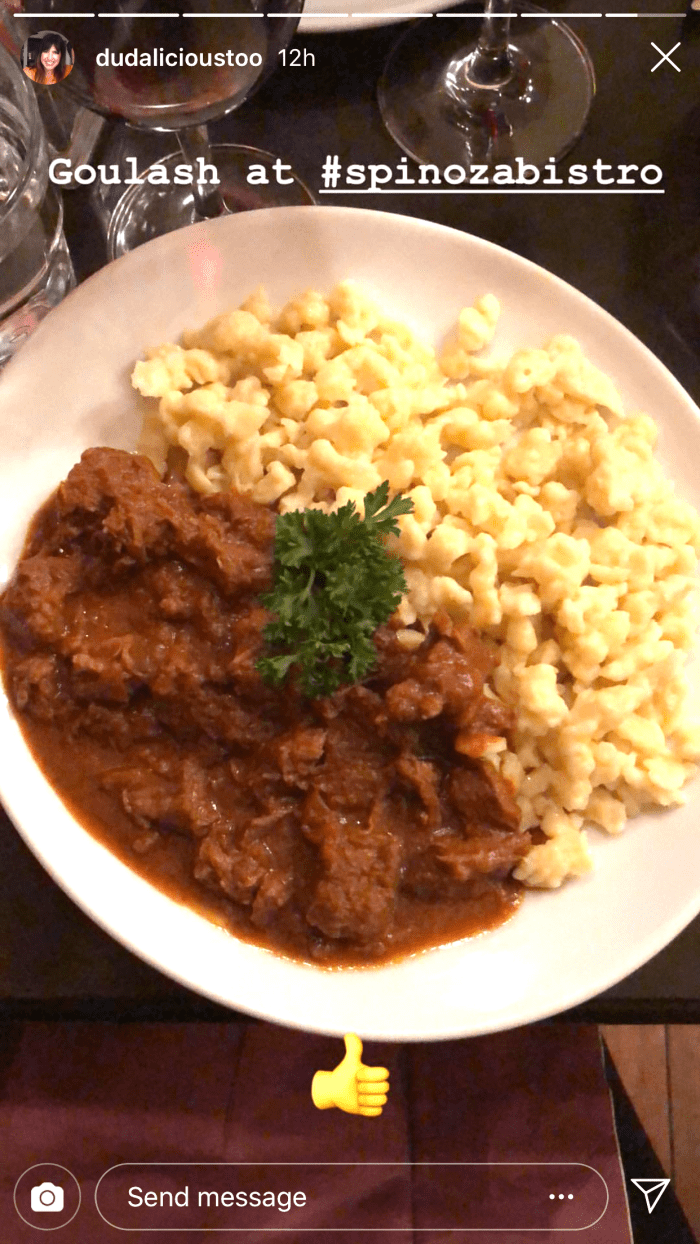
As well as that classic Hungarian dish, I tried the Schnitzel and the Spaetzle as well – see them here:
If you enjoy these posts, why not subscribe and never miss out? It’s easy, and there are NO ads of any kind, just stuff I like – from music to movies, books, travel, food and more…click on the main page and “follow” me on the upper right…
If you like the story, share it with friends on social media! Thanks!
Let me know if you’ve ever had the chance to see a Hungarian “ruin bar!”

Categories: Alcohol And Bars, Bite Eat Swallow, Bite! Eat! Repeat!, Food, Food Travel, Restaurants, Travel, Wacky Food, Wine, World's Wildest Food
 Bite! Eat! Repeat!
Lovely! I have a friend who lived there for many years and it is still her favorite city.
We loved our two days in Budapest as well. We arrived at night by boat and everything was lit up. I was so excited I almost burst. The food was amazing. Hubby loved the goulash and had it twice. I enjoyed the spaetzle.
What fun! I just finished Kirsten’s post about Budapest – https://theflaskhalffull.com/2025/12/03/🇭🇺-a-food-tour-of-budapest-you-only-think-youre-full/?jetpack_skip_subscription_popup. She’s really funny! I’d never heard of ruin bars prior to today!
Got ‘here’ just after Mimi and reading Kirsten’s very well written post as well 🙂 ! Well, after having been married to a Budapest-born foodie aristocrat for four years and spending some 3 months in the fabulous city one summer way, way back . . . I am just sorry you did not have more time in that hugely civilized and elegant city! Somehow I do not think all these restaurants and bars were established in the mid- or late 1980s and I do not remember ever being taken to the Jewish quarter . . . so I am learning now 🙂 !
Loved this, John! Great history and wonderful food!
Hungary was a European destination that I never got to. Thanks for taking me there with this interesting travelogue, John.
Best wishes, Pete.
Thanks Pete! They are trying to modernize under a repressive regime – their upbeat energy and eagerness to live life was great to see